Membership renewal: 14 ways to raise your renewal rate
Membership renewal strategies for associations: measuring renewal and lapse rates, a reminder timeline, auto-renew, grace periods and lapsed-member win-back.
- Author
- Luca Longo
- Published
- Reading time
- 13 min read
Membership renewal is the quietest number in an association and the one that decides most of its budget. A club that recruits sixty new members a year and loses eighty is shrinking, however busy the membership committee looks. Yet most boards see renewal once a year, after the fact, as a single percentage in the treasurer's report. This article is for the secretary, treasurer or membership committee that wants to raise that percentage. It sets out how to measure renewal properly, what a reminder timeline should look like, and fourteen membership renewal strategies that work for dues-paying organisations of a few hundred to a few thousand members.
The renewal cycle, and why it is usually invisible
Every membership has a date on which it must be renewed: the first of January for calendar-year associations, the anniversary of joining for others, the start of the season for clubs. Around that date there is a short window in which the member decides, often without noticing they are deciding. They pay, or they put the letter aside, or they do not see it at all.
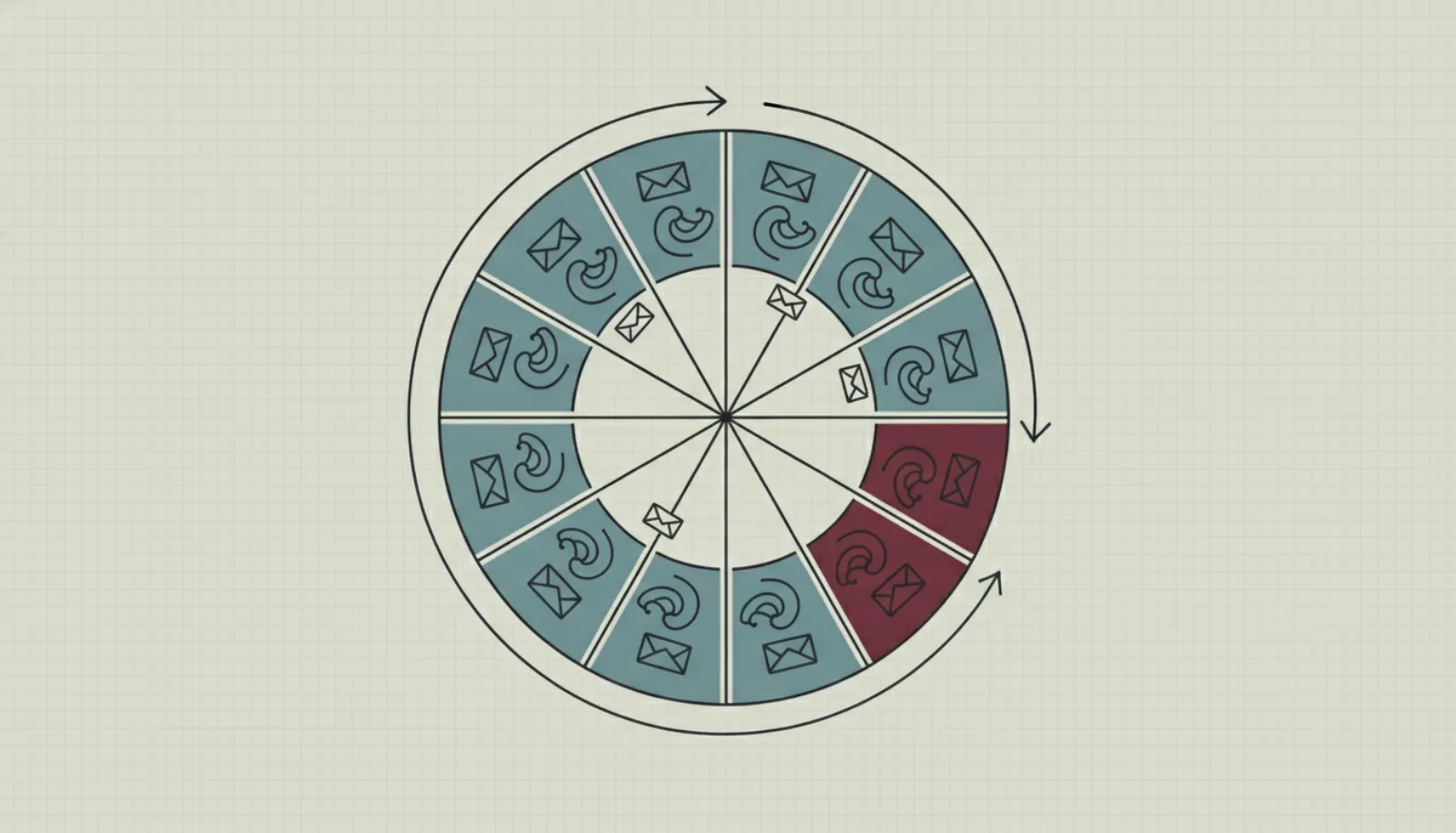
The cycle therefore has four phases. Before the due date, the member is reminded that renewal is coming and given an easy way to pay. On the due date, the invoice falls due. After the due date, during the grace period, the member is still in good standing but has not paid. After the grace period ends, the member lapses: they lose their rights and drop out of the count. Each phase is a place where members are lost or kept, and each one can be managed.
What makes the cycle invisible is that in most associations it is spread across a mail merge, a bank statement, a spreadsheet and the memory of the person who ran it last year. Nobody sees the whole thing at once. The first strategy, then, is to see it.
How to measure membership renewal
Agree the definitions before you agree the targets. Three figures are enough, and they must be calculated the same way every year.
Renewal rate. Of the members whose renewal fell due in the period, the share that renewed.
Renewal rate = members who renewed ÷ members due to renew × 100
Lapse rate. The complement: the share of members due to renew who did not.
Lapse rate = (members due to renew − members who renewed) ÷ members due to renew × 100
Retention rate. Of the members you had at the start of the year, the share still in good standing at the end, ignoring new joiners. This is the figure to compare with other associations, because it is not distorted by recruitment.
Retention rate = members at end of year who were also members at start ÷ members at start × 100
Two points of method. First, exclude from the denominator the members who could not renew: the deceased, life members who pay nothing further, honorary members. Second, decide when a non-renewal counts as a lapse. If your grace period runs to 31 March, the renewal rate for the year cannot be known until April, and a figure quoted in February is a forecast.
Then segment. A single rate hides the pattern. Calculate it by tier, by chapter, by join year and by payment method. In almost every association we have seen, first-year members renew at a much lower rate than members of five years' standing, and members paying by bank transfer lapse more than members paying by card from the portal. Those two facts alone tell you where to work.
| Measure | Formula | What it tells you |
|---|---|---|
| Renewal rate | Renewed ÷ due to renew | How well the renewal process works |
| Lapse rate | 1 − renewal rate | How many members you must recruit to stand still |
| Retention rate | Still members at year end ÷ members at year start | The figure to benchmark year on year |
| First-year renewal rate | Renewed ÷ due, for members in their first year | Whether onboarding works |
| Win-back rate | Lapsed members reinstated ÷ lapsed members | Whether the win-back campaign works |
A membership renewal timeline that works
The reminder sequence is where most of the gain is. The common pattern is one invoice and one reminder, both by post or by a single email, and then silence. The pattern that works is more touches, shorter, each with one action, spread across the due date rather than bunched before it.
| When | What | Channel | Note |
|---|---|---|---|
| 60 days before | Renewal notice: what is due, when, how to pay in one click | Mention what the member had from the association this year | |
| 30 days before | Invoice issued, with portal link and bank details | Email, portal | The invoice is the formal document; the notice was the warm-up |
| 7 days before | Short reminder, one line, one button | Members who have paid are excluded automatically | |
| Due date | "Your membership renews today" | Confirmation to those who paid; reminder to those who have not | |
| 14 days after | First overdue reminder, plain and friendly | Still in good standing during grace | |
| 30 days after | Second overdue reminder: grace ends on a date, here is what you lose | Name the date and the consequences | |
| 7 days before grace ends | Personal contact from a committee member or chapter officer | Phone, personal email | For the members you most want to keep |
| Grace ends | Status set to lapsed; portal access to member sections closes | System | Automatic, no judgement involved |
| 60 and 180 days after lapse | Win-back message | Reinstate without a new application |
The point of the table is not the exact days, which depend on your statute and your season. It is that every message is excluded for members who have already paid, that the sequence continues after the due date, and that the last step before lapse is a person rather than a template.
Fourteen membership renewal strategies
1. Measure before you change anything
Calculate the renewal, lapse and retention rates for the last three years, by tier and by join year. Without a baseline you will not know whether anything you do next has worked, and you will argue about it at the board.
2. Make the renewal date visible all year
A member who knows their membership ends on 31 December is less surprised by the invoice than one who finds out in the invoice. Put the renewal date on the portal home screen, on the membership card and in the footer of the newsletter.
3. Invoice by rule, on time, automatically
A renewal invoice issued three weeks late because the office was busy with the AGM shortens the window and signals that dues are not urgent. The invoice should go out on the day the rule says, for every tier, without anyone pressing a button. See dues and payments for how this is configured.
4. Run the full reminder sequence
Most associations stop at one reminder. The sequence above has five touches before lapse. Each one recovers members the previous one missed, and because paid members are excluded, nobody who has renewed is nagged.
5. Write the reminders in your own words
A template that says "Your invoice #4471 is overdue" reads as a utility bill. A template that says "Your membership of the club ends on 31 March; here is what happened on the water this year, and here is the button" reads as a club. Every automatic message should be editable by the office, in each language you use.
6. Make paying take one minute
Each step between the reminder and the receipt loses members: logging in, finding the invoice, typing an IBAN, waiting for the treasurer to confirm. The reminder should carry a link that opens the invoice already paid-ready, with card and SEPA as options and bank transfer as the fallback. The member portal is where this lives, and it must work on a phone.
7. Offer auto-renew, with consent
Members who opt into automatic renewal do not lapse through forgetfulness, which is the main reason members lapse. The conditions matter: explicit opt-in, a clear notice before each charge with the amount and the date, and a one-click way to turn it off. Automatic renewal without those is a complaint waiting to happen and, depending on your jurisdiction, a legal problem.
8. Use the grace period deliberately
A grace period is not a soft deadline; it is a defined window during which the member is still in good standing and still being reminded. Set it in your rules, publish it, and apply it the same way to everyone. A grace period that varies by who the treasurer likes is a governance problem.
9. Chase first-year members differently
A member in their first year has not formed the habit. Add a personal touch for them: a welcome call three months in, an invitation to a specific event, a named contact. Their renewal is decided by whether they found a reason to belong, and that is settled long before the invoice.
10. Segment the chase by value and by risk
Not every lapse costs the same. A corporate member or a long-standing member who has gone quiet deserves a phone call from a board member before the grace period ends. The register should let you list members due to renew who have not paid, filtered by tier, chapter and years of membership, so the committee can divide the calls.
11. Ask lapsed members why
A two-question message after lapse, "Why did you not renew?" and "Would you come back?", with the answers kept on the record, tells you more than any survey of current members. Common answers are moved away, cost, did not use it, and did not know it was due. Only the last two are yours to fix, and they are often half the total.
12. Run a win-back campaign
A lapsed member is far easier to reinstate than a stranger is to recruit. Keep lapsed members in the register with their history, send a message at 60 and at 180 days, and let them reinstate from the portal without a new application or a joining fee. Track the win-back rate as its own figure.
13. Report renewal to the board every quarter
The board should see renewal, lapse and retention by tier and chapter at every meeting, year on year, not once in the annual report. When the figure is on the agenda it gets attention; when it is on page nine of the accounts it does not. A report preset that produces the same view each quarter removes the preparation. See campaigns and reports.
14. Give members a reason to stay
None of the above matters if the association does nothing the member values. Renewal rises when members attend events, appear in the directory, use their qualifications, vote at the meeting. Measure participation alongside renewal, and look at the members who did nothing this year: they are next year's lapses.
A worked example: the Northshore Rowing Club
The Northshore Rowing Club is fictional, with numbers typical of a mid-sized club. It has 820 members on a calendar year: 560 senior at €240, 180 junior at €120, 80 social at €60. Dues income is 560 × €240 + 180 × €120 + 80 × €60 = €134,400 + €21,600 + €4,800 = €160,800.
Last year the club sent one renewal letter in December and one reminder in February. Of 820 members due to renew, 672 renewed: a renewal rate of 672 ÷ 820 = 82 per cent, and a lapse rate of 18 per cent. The committee recruited 95 new members, so the club ended the year at 767 and called it stable. The segmented figures were worse: first-year members renewed at 61 per cent, members paying by bank transfer at 76 per cent, members paying by card from the portal at 93 per cent.
The club made four changes. It moved to the reminder sequence above, with the invoice on 1 December and a grace period to 28 February. It offered auto-renew at the point of payment, which 210 members accepted. It assigned every first-year member a named committee contact who called in September. And it added a win-back message to the 148 members who had lapsed the year before.
The following year, 820 members were due to renew. 738 renewed, a renewal rate of 90 per cent. First-year renewal rose to 74 per cent. Of the 148 previously lapsed, 31 reinstated, a win-back rate of 21 per cent. Dues income from existing members rose by roughly 66 × €200 = €13,200 on the renewals alone, plus around €6,000 from the reinstated members, against perhaps forty fewer hours of the treasurer's time chasing bank transfers.
None of the changes was expensive. All of them depended on seeing the figures by segment and on the system sending the right message to the right member at the right time without anyone remembering to do it.
Common mistakes in membership renewal
Measuring once a year. By the time the annual figure appears, the lapsed members have been gone for months. Renewal is a quarterly agenda item.
Counting recruitment as retention. A club that recruits as many as it loses looks stable and is in fact replacing its membership every six years, with all the cost that implies.
One letter and silence. A single reminder recovers the members who were going to renew anyway.
Reminding members who have already paid. Nothing irritates a loyal member more. Every reminder must be computed against payments received that morning.
Treating lapse as the end. A lapsed member who is deleted from the register cannot be won back and takes their history with them.
Auto-renew without consent or notice. It saves lapses and costs trust, and in many places it is unlawful without an explicit opt-in and advance notice.
Letting the grace period drift. A deadline applied differently to different members undermines the statute and the treasurer.
Fixing the reminders and not the club. If members did nothing with their membership this year, better emails will not keep them next year.
How SupaGuild handles membership renewal
SupaGuild issues renewal invoices by the rule of each tier, calendar year, anniversary or season, and sends reminders before the due date, on it and after it, each with wording the office writes in every language it uses. Members pay by card or SEPA into the association's own Stripe account from the portal, or by bank transfer against the reference on the invoice. Members who opt in to automatic renewal receive a notice before each charge. When the grace period set for the tier ends, the membership is marked lapsed, the member loses access to member-only sections of the portal, and the lapse appears in the report.
The reporting view shows members by tier and chapter, joiners, renewals and lapses, year on year; report presets save the views the board asks for, and on the Pro plan they export as a branded PDF. Lapsed members stay in the register with their history, so a win-back campaign can be sent to them as a segment and a reinstated member keeps their record. The dues and payments and campaigns and reports pages describe what is shipped; the pages for the treasurer and the membership committee describe how each role uses it.
Frequently asked questions
What is a good membership renewal rate?
It depends on the kind of association and on how you count. Professional bodies whose membership is a credential tend to renew in the high eighties or nineties; clubs and societies with a social membership often sit in the seventies and eighties. Compare your own rate year on year and by segment rather than against a published average, and treat the first-year renewal rate as the figure that reveals the most.
How is the membership renewal rate calculated?
Divide the number of members who renewed by the number of members whose renewal fell due in the period, and multiply by one hundred. Exclude members who could not renew, such as life members and the deceased. Wait until the grace period has ended before treating the figure as final.
How many renewal reminders should we send?
More than one and fewer than a nuisance. A sequence of five or six touches, starting around sixty days before the due date and continuing through the grace period, works for most associations, provided every message is suppressed for members who have already paid and the final touch before lapse is personal.
Should an association offer automatic membership renewal?
Yes, where the members opt in explicitly, receive a notice with the amount and date before each charge, and can switch it off in one click. Auto-renew removes forgetfulness, which is the most common cause of lapse. Without consent and notice it damages trust and may breach consumer rules in your jurisdiction.
How long should the grace period be?
Long enough to run the full reminder sequence and short enough that the register means something: between thirty and ninety days is common. Set it in your rules per tier, publish it to members, and apply it automatically so that it does not depend on the treasurer's judgement.
How do we win back lapsed members?
Keep them in the register with their history, write to them at around sixty and one hundred and eighty days after lapse, ask why they left, and let them reinstate from the portal without a new application. Measure the win-back rate separately from the renewal rate, and expect it to be well above the rate at which you convert strangers.